
TLDR:
- There are three types of AI tools right now: chatbots (ChatGPT, Gemini), open-source agent frameworks (Open Claw), and agentic platforms (Claude Cowork).
- Every tool trades off between three dials: Power, Security, and Simplicity. You can't max all three.
- ChatGPT is easy but disconnected from your business. Open Claw is powerful but requires a dev team. Claude Cowork threads the needle for most business owners.
- The plugin layer is what makes it scale: version control, portability, and onboarding that actually works.
- Most businesses are still stuck in Camp 1. The window for competitive advantage is wide open.
If you're a business owner trying to figure out which AI tool to invest your time in, you've got three choices. And there's a very good chance you're spending your time in the wrong one.
I talk to founders and marketers every week who ask me some version of this question: "I've been using ChatGPT, but I keep hearing about agents and autonomous AI and all these new tools. What should I actually be using?"
The answer depends on three things. And once you understand the trade-offs, the decision gets very clear.
The Three Camps
- Camp 1: ChatGPT, Gemini, and the chatbots everybody knows. You type a question, it gives you an answer. Maybe you used it to rewrite a subject line once. Maybe you asked it to summarize an article. You told your team "we're using AI now" and moved on.
- Camp 2: Open Claw and the open-source agent frameworks. Maximum power. The people in this camp are automating 5% of their business per week (or so they claim on podcasts). They've got developers. They've got infrastructure. They've got a tolerance for things catching fire at 2 AM.
- Camp 3: Claude Cowork and the agentic platforms. This is the one almost nobody is talking about yet. And it's where the actual adoption wave is heading.
The Three-Dial Framework
Here's a mental model I've been using with every business owner who asks me "what should I be doing with AI right now?"
Think of three dials: Power, Security, and Simplicity. You can't max all three. Every AI tool makes a trade-off between them.
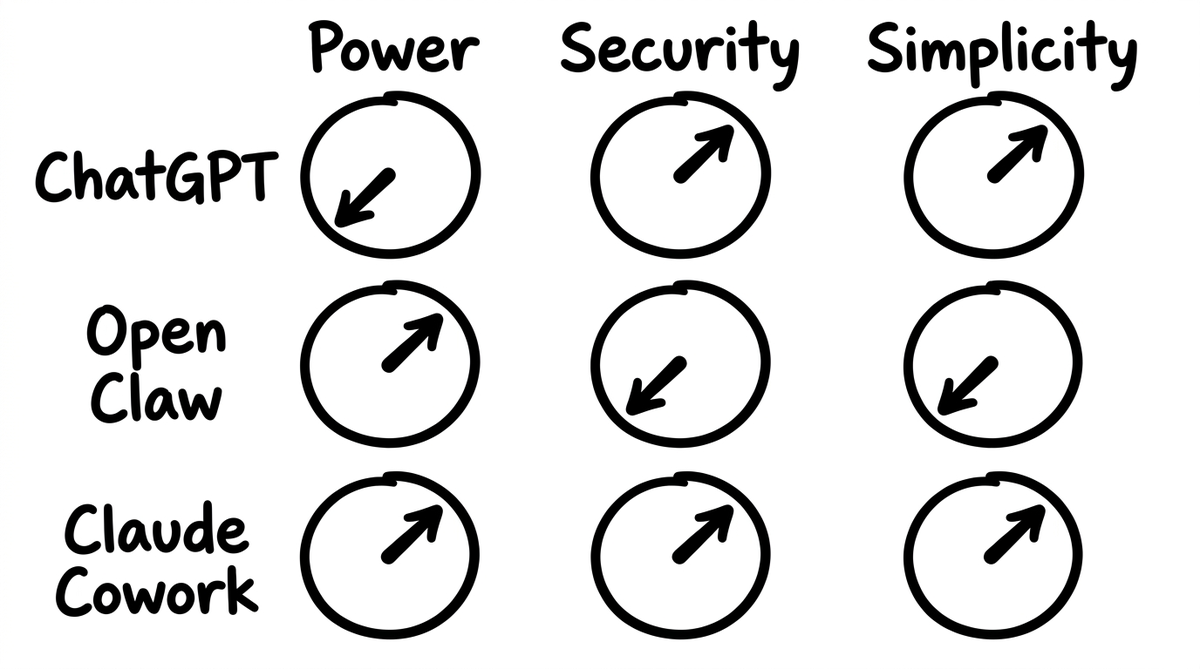
ChatGPT sits at maximum simplicity. Anybody can use it in about 30 seconds. But the power dial is basically at zero. It answers questions. It doesn't do anything. It's not connected to your systems. It doesn't know your inventory, your customers, your processes. It's a very smart stranger who knows nothing about your business and gets amnesia every time you close the tab.
Open Claw cranks power to 10. These frameworks can connect to anything, operate autonomously, and run real workflows across your entire stack. But security? You're running open-source code with full system access. Simplicity? You need a developer (or several) just to get it stood up. When I talk to people running these setups, they describe spending weeks just getting competent with the tooling.
Claude Cowork is the middle. Agentic AI that's actually usable by people who aren't developers. Connected to your systems, aware of your business, running real processes. With guardrails so it can't email your entire customer list at 3 AM.
| ChatGPT, Gemini | Open Claw | Claude Cowork | |
|---|---|---|---|
| Power | Minimum | Maximum | Medium-High |
| Security | Maximum | Minimum | Medium-High |
| Simplicity | Maximum | Minimum | Medium-High |
| Pros | Anyone can use it in 30 seconds | Connects to anything, full autonomy | Connects to your systems, no dev required |
| Cons | No system access, no memory, very little agentic capability | Needs developers, breaks often | Less customizable than open-source |
| Best for | Quick Q&A, one-off drafts | Funded startups with engineering teams | Business owners running real workflows |
Why ChatGPT Isn't Enough Anymore
If you're reading this, there's a solid chance ChatGPT is your primary AI tool. You're not alone. It's the most widely adopted AI tool on the planet. It's also the least useful for actually running a business.
I hear this all the time from business owners: "Yeah, we're using AI." And when you press them, what they mean is someone on the team tried ChatGPT a few times for brainstorming or content drafts. Maybe they rewrote a subject line. Maybe they summarized a call.
That's a parlor trick.
The gap between "tried AI" and "using AI to grow" is enormous. And you can't close it with a chatbot, no matter how smart the model gets.
Why? Because ChatGPT is disconnected from your business.
It's siloed in a cloud application making the user (that's you and me!) work too hard to get it the context and connectors it needs to get real business growth work done.
The Open Claw Argument (And Why It Doesn't Scale for Most)
If you listen to the All-In podcast, you've heard Jason Calacanis talking about automating 5% of his business every week using maximum-power AI setups. He brings founders on the show who are going full send with open-source frameworks like Open Claw.
It sounds incredible. And honestly, for a well-funded startup with a few dedicated engineers who can babysit the system, it probably is.
What most people skip past: J Cal's got a couple of dev nerds in there whose entire job is to make that work. Most businesses don't have that. Most businesses have a founder, maybe a small team, and a to-do list that's already longer than the day.
The open-source agent route is a real bet. You're buying Mac minis. You're managing API keys. You're wiring together systems that weren't designed to talk to each other. And when something breaks (it will), you need someone who can dig into the code and fix it. At 2 AM. On a weekend.
For a certain type of company, that's the right play. For most? It's a couple of expensive weeks that end with "okay, where are we with this?"
Why Claude Cowork Is Where We Landed
Let me be direct about my bias here: I use Claude Cowork every day. It's the tool I've built my entire business around. So take this recommendation with that context. But I'll explain why I chose it, and you can decide if the same reasoning applies to you.
A chatbot answers your question. An agent does the work.
Claude Cowork connects to your Slack, your Gmail, your Notion, your Zoom, your CRM, your newsletter platform. It reads the files in your workspace. It builds documents, sends emails, creates pages, runs multi-step processes.
It has what I call ambient awareness of your entire business.
It knows what's on your website. It knows your product catalog. It knows your brand voice because it's literally reading the files that define it.
I've got my setup configured so I can press a button, describe what I want in plain English, and watch it go build a web page. Not "draft some copy I then paste somewhere." Actually build the page, push it live, and move on to the next thing. No developer between me and the output.
That's the gap. "I used AI to help me write something" versus "AI built the thing and shipped it." One of those changes your Tuesday. The other changes your business.
Claude Cowork vs ChatGPT Agent at a Glance
Most searches that bring people to this article are some variation of "Claude Cowork vs ChatGPT Agent." So here's the direct head-to-head.
| ChatGPT Agent | Claude Cowork | |
|---|---|---|
| What it is | OpenAI's autonomous task mode inside ChatGPT | An agentic AI platform with a plugin architecture for business workflows |
| System integration | Limited to OpenAI's built-in connectors | Native connection to Slack, Gmail, Notion, CRMs, and any MCP server |
| Persistent context | Per-session, scoped to that task | Persistent across sessions via project files and skills |
| Plugin layer | Custom GPTs (locked inside ChatGPT, not portable) | Plugins live on GitHub. Portable, shareable, versionable across your team |
| Local file access | No | Yes, reads your computer's files directly |
| Best for | One-off autonomous browsing or task completion | Running sustained business processes with team-wide consistency |
The summary: ChatGPT Agent is a feature inside a chatbot. Claude Cowork is the chatbot reorganized into an operating layer for your business.
The Plugin Layer (This Is the Part That Scales)
The tools in Camp 3 share a feature that a chatbot can't match: a plugin system and a community of developers lining up to add to it.
A plugin is a packaged process. It contains skills (instructions for how to do something), reference files (brand voice, customer personas, product catalogs), connectors to external tools, and sometimes little bits of software. You roll it all up into a single package, and anyone can install it.
This matters at scale. A lot. Because:
- Version control. Your plugins live on GitHub. When a manager updates a process, everybody gets the update. No more "which version of the SOP are you looking at?" conversations. (If you've ever had that conversation, you just felt a little jolt of recognition.)
- Portability. Got a high performer who built something brilliant? Tell them to package it as a plugin. Now the whole team has it. You're cloning your best people's workflows without cloning your best people.
- Onboarding. New employee gets their laptop with their AI terminal and the plugins for their department. The AI walks them through it. It teaches them. It knows itself, so it can explain how it works, run test scenarios, and get that person productive in days instead of weeks.
- Top-down control with bottom-up innovation. Leadership controls the core files (mission, offers, brand voice, quarterly priorities) that everyone's AI reads from. Everyone's playing from the same sheet of music. But individual contributors can build and customize their own workflows. When one of those workflows turns out to be good, you promote it to a plugin and roll it out company-wide.
This is the architecture that actually works for a company with 100 employees. ChatGPT can't touch it (no system access, no persistent context). Open Claw can do it but requires a dev team to maintain. Claude Cowork gets you 80% of the power with 20% of the complexity. For most businesses, that math is a no-brainer.
Claude Cowork vs ChatGPT vs Open Claw: Which Should You Use?
Here's the honest answer:
Use ChatGPT if you just need quick answers and one-off drafts. It's a great research tool. It's a great brainstorming partner. If your AI needs stop at "help me think through this" and "rewrite this paragraph," ChatGPT (or Gemini, or Copilot) is perfectly fine. Stay in Camp 1. There's no shame in it. Just know you're using about 5% of what AI can do for your business.
Use Open Claw if you have a dedicated technical team, you want maximum control and customization, and you're willing to invest weeks in setup and ongoing maintenance. If you've got the engineering resources and the appetite for complexity, Camp 2 delivers serious power. This is the right choice for funded startups and companies with dedicated AI engineers.
Use Claude Cowork if you want agentic AI that actually runs your workflows, connects to your tools, and doesn't require you to become a developer. If you're a founder or marketer who wants to go from "I use AI sometimes" to "AI runs half my operations," this is where I'd start. The Quick Start takes about 20 minutes and you'll have a working agent the same day.
Which AI tool should you use? Follow the decision tree.

And here's the part that should keep you up at night (in a good way): most businesses are asleep on Camp 3. Especially the big ones. The larger the company, the slower they move. Which means the window for smaller, nimbler companies to build a real advantage is wide open.
I talked to a founder recently who told me he was ready to walk away from his business. Bored. Burned out. Four days later, he started building his first AI agent setup. His exact words: "My brain is on fire."
That's what happens when you find the right tool and start building.
Frequently Asked Questions
Is Claude Cowork the ChatGPT equivalent?
No. Claude Cowork is an agentic AI platform that connects to your business tools (Slack, Gmail, Notion, CRM), reads your files, and runs multi-step workflows. ChatGPT is a chatbot that answers questions in isolation. The two solve different problems.
What is the ChatGPT equivalent of Claude Cowork?
There isn't a direct ChatGPT equivalent. Custom GPTs offer a thin layer of customization but remain isolated in OpenAI's cloud with no access to local files or business systems. ChatGPT Agent mode is the closest agentic comparison, but it still lacks Cowork's plugin architecture and persistent system access.
Should I use Claude Cowork or ChatGPT Agent?
Use Claude Cowork if you want agentic AI that connects to your existing business tools, reads your files, and runs real workflows without a developer. Use ChatGPT Agent for one-off autonomous browsing tasks that don't require persistent context or system integration.
Can ChatGPT do what Claude Cowork does?
For most business workflows, no. ChatGPT lacks persistent context, file system access, and the plugin architecture that lets Claude Cowork chain skills together across Slack, Gmail, Notion, CRMs, and other tools. ChatGPT excels at one-off responses. Cowork is built to run sustained processes.