

TLDR:
- The "build the Wikipedia of your topic" content strategy is collapsing. The biggest content operations on the internet are losing massive organic traffic. HubSpot, Business Insider, NerdWallet, Dotdash Meredith are all getting hit.
- Nearly 60% of Google searches now end without a click. When AI Overviews appear, click-through rates drop by 58%. The distribution channel that made the strategy work is being dismantled.
- AI collapsed content creation costs to near zero. When everyone can produce articles for pennies, the supply becomes infinite and the value of each article approaches zero.
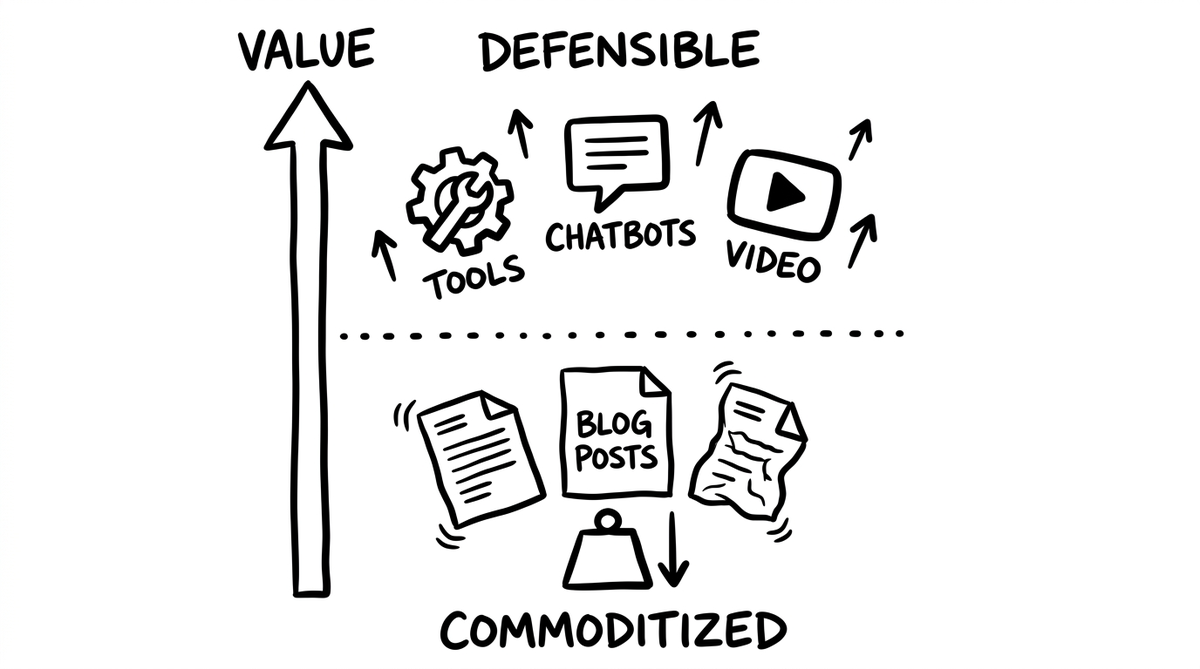
- The businesses winning now are building interactive tools, AI chatbots trained on proprietary knowledge, video/audio content, and software-like experiences.
- Pick one origin channel for original thought (YouTube, podcast, newsletter), let AI repurpose it, and build interactive destinations on your website. Stop writing articles as your primary strategy.
Here's a subtle comment:
Your giant SEO optimized content library has become worthless.
Or, it's not valuable for the same reason it was back in 2021.
The strategy that built top-of-funnel SEO content empires ("become the Wikipedia of your topic, publish hundreds of articles, own every keyword") hit a brick wall.
AI collapsed the cost of creating that content to zero. And Google, the distribution channel that made it all profitable, is now answering the questions itself.

This article breaks down:
- What killed the old playbook
- Five content types AI can't commoditize
- The new content stack
- What to do with the content you've already built
If you've been grinding out top-of-funnel SEO blog posts as your primary growth strategy, this is your exit ramp.
The Old Content Marketing Playbook (and Why It Worked)
The playbook was simple:
- Publish exhaustive informational content
- Dominate long-tail keywords
- Capture search traffic
- Convert with lead magnets
- Own every unbranded keyword search in your niche
Become the Wikipedia of your topic.
And for over a decade, it worked beautifully.
HubSpot built a blog empire so large it drove their entire inbound marketing thesis. The blog wasn't a marketing channel. It was the proof of concept for their product.
NerdWallet became a publicly traded company largely on the back of SEO-driven content covering every personal finance question imaginable.
Dotdash Meredith assembled a portfolio of content sites (Investopedia, Verywell Health, The Spruce) each designed to be the definitive resource in its vertical.
The economics were predictable. Google rewarded volume and comprehensiveness. Creating quality content at scale was expensive and slow. The barrier to entry was effort and expertise.
If you put in the work, Google sent you traffic. Rinse, repeat, compound.
Then it stopped.
The Collapse (and the Numbers Are Brutal)
Fair warning: this section is data-heavy. That's intentional. If you're going to blow up your content strategy, you deserve to see the receipts. This is a structural collapse.
The Supply Side: AI Crushed Creation Costs
AI collapsed the cost of content creation to near zero.
The barrier to entry that made the "Wikipedia" playbook work (effort, expertise, cost) evaporated overnight. When anyone can produce articles for pennies, the supply becomes infinite. And when supply is infinite, the value of each unit approaches zero.
That's Econ 101.
The moat was always "we put in more work than our competitors."
AI filled that moat with concrete.
The Distribution Side: Google Is Keeping the Traffic
Nearly 60% of Google searches now end without a click to any website.
Google's AI Overviews are expanding fast, and informational queries still make up 57% of all AI Overview triggers. That's the exact content type the "Wikipedia" strategy targets.
The queries where you wrote those 200 blog posts? Google is answering them in the search results now.
When AI Overviews appear, click-through rates to the #1 organic position drop by 58%.
You could be ranking first and still losing more than half your clicks.
Ahrefs calls this "The Great Decoupling": search usage continues to rise while clicks to websites decline.
More people searching. Fewer people clicking.
Google is the destination rather than the directory.
The Double Hit
Your content is easier to replicate (AI) AND harder to distribute (Google keeping clicks). That's not a headwind. That's a wall.
What's Replacing It (Five Content Types AI Can't Commoditize)
So what do you do when the library strategy dies?
You stop building a library and start building experiences.
Five content types are proving durable against AI commoditization. Here's what they have in common: they all require someone to visit your site and do something, not just read something.
1. Interactive Experiences
Tools. Calculators. Quizzes. Bracket voting systems. All built on your website.
I built an entire tournament bracket system in a weekend using Claude. That's software. You can't copy-paste it. You can't AI-generate a clone by typing "write me a bracket tournament."

It's defensible by nature.
Interactive content lives on your domain. It requires a visit to use. Google can't summarize a calculator in an AI Overview.
2. Proprietary Data and AI Chatbots
Spiro (one of our members in theCLICK Pro) took 13 years content about gout and trained a JotForm chatbot on all of it. The chatbot now handles his customer service questions. Eliminated his support emails entirely.
But here's the bigger insight: that chatbot makes his site more valuable than any individual blog post. It contains proprietary information that generic AI can't replicate from training data.
3. Video and Audio
AI still can't replicate a person on camera being themselves.
It can generate synthetic video (and it's getting better, which is a whole other conversation).
But audiences can tell.
And more importantly, audiences form trust with real people in ways they simply don't form trust with text on a screen.
Victoria Westcott, another theCLICK Pro community member, earns $60K a year from affiliate revenue on a YouTube channel about cleaning businesses.
She has ~1,500 subscribers. She publishes once a month.
Let that math sink in for a second.
Ed Lawrence, a 20-year YouTube veteran who's worked with some of the biggest creators on the platform, says authenticity is becoming more valuable as AI floods every other channel.
The format matters more than the frequency.
(BTW… here's my YouTube channel where I share lots of AI marketing info and tutorials.)
4. Community-Generated Content
Content that comes from a community is unique by definition.
You can't AI-generate a member's real story. You can't fabricate the specific results someone got using your product or service.
This is content that gets created because people are doing things together.
It's a byproduct of activity rather than something you put on a content calendar.
5. Software-Like Content
Plugins, skills, workflows that readers can install and use. Not content you read. Content that works for you. This is the frontier.
Look at what HubSpot is doing. Even as their blog traffic craters, they're investing heavily in HubSpot Academy, free tools, and integrations. They're shifting from "read our blog post about email marketing" to "use our free email tool." The content IS the product.
The New Content Stack
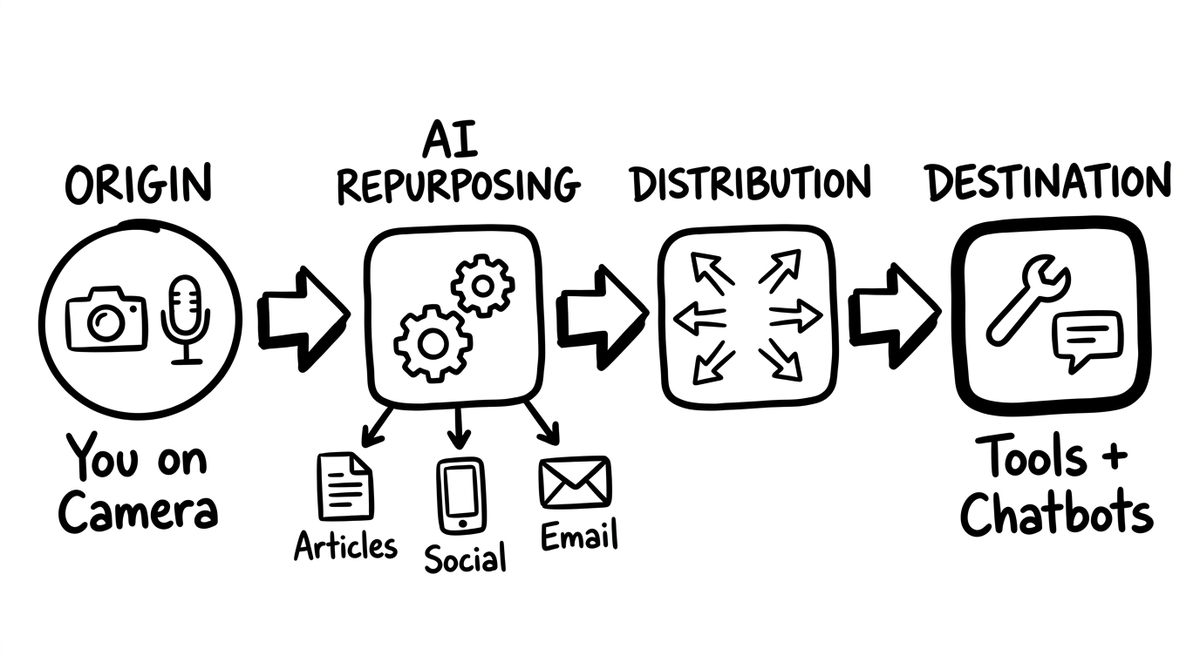
Here's the framework that replaces the old content marketing playbook. Three layers, one formula.
Layer 1: Pick one origin channel for original thought.
YouTube, podcast, newsletter, or webinars. This is where you create, on camera or in your own voice, the ideas that only you can have.
Video and audio are the hardest formats for AI to replicate.
Layer 2: Let AI repurpose across channels.
AI is perfect for this step. Turn your video into:
- Articles
- Social posts
- Email sequences
- Short-form clips (tools like Opus Clip do this automatically)
AI as amplifier, not creator. Claude Cowork can handle most of this repurposing once you've set up the workflows.
Layer 3: Replace informational blog posts with interactive destinations.
On your website, swap out the content library for:
- Interactive tools
- Chatbots trained on your proprietary knowledge
- Software-like experiences
The website becomes a destination people use, not a reading list people skim.
The formula: Human origin + AI repurposing + interactive destination.
This is exactly what the survivors are doing.
"But I've Already Built 200 Blog Posts"
Relax. Your existing content library is raw material.
Here's what to do with it:
- Train an AI chatbot on it (like Spiro did with JotForm). Now your 200 articles become the knowledge base for an interactive experience that's more valuable than the articles ever were individually.
- Consolidate thin articles into comprehensive, tool-augmented pages. One interactive page that actually helps someone solve a problem beats ten informational articles that describe the problem from slightly different angles.
The content doesn't disappear. It transforms into something AI can't replicate: a proprietary knowledge system that lives on your domain and requires a visit to use.
Stop writing top-of-funnel SEO blog posts as your primary strategy. That's the shift.
Articles still serve a purpose. They give search engines and AI discovery tools something to index. They give you material to link from social and email.
The businesses that built on owned channels (email lists, YouTube subscribers, communities) are the ones still standing. The businesses that built on rented land are watching the landlord demolish the building.
The Real Competitive Edge Is Being Human
Knowledge is still a moat.
But stop pouring it into a format that's been commoditized and start pouring it into formats that haven't.
Business Insider's CEO called this "a major shift in how people find and consume information." She's right.
The shift is away from content that any AI can produce.
The question for every piece of content you create is now: "Could an AI make this without me?"
If yes, it's already worthless.
The playbook that built content empires is over.
The playbook that builds the next ones starts with:
- You on camera
- Your proprietary knowledge in a chatbot
- Your website acting less like a library and more like an app
The era of content-as-reading-material is ending.
The era of content-as-experience is here.
And honestly? If you've got 15 years of expertise and you're still spending your weeks writing blog posts...
… you're bringing a typewriter to an AI fight.