

TLDR:
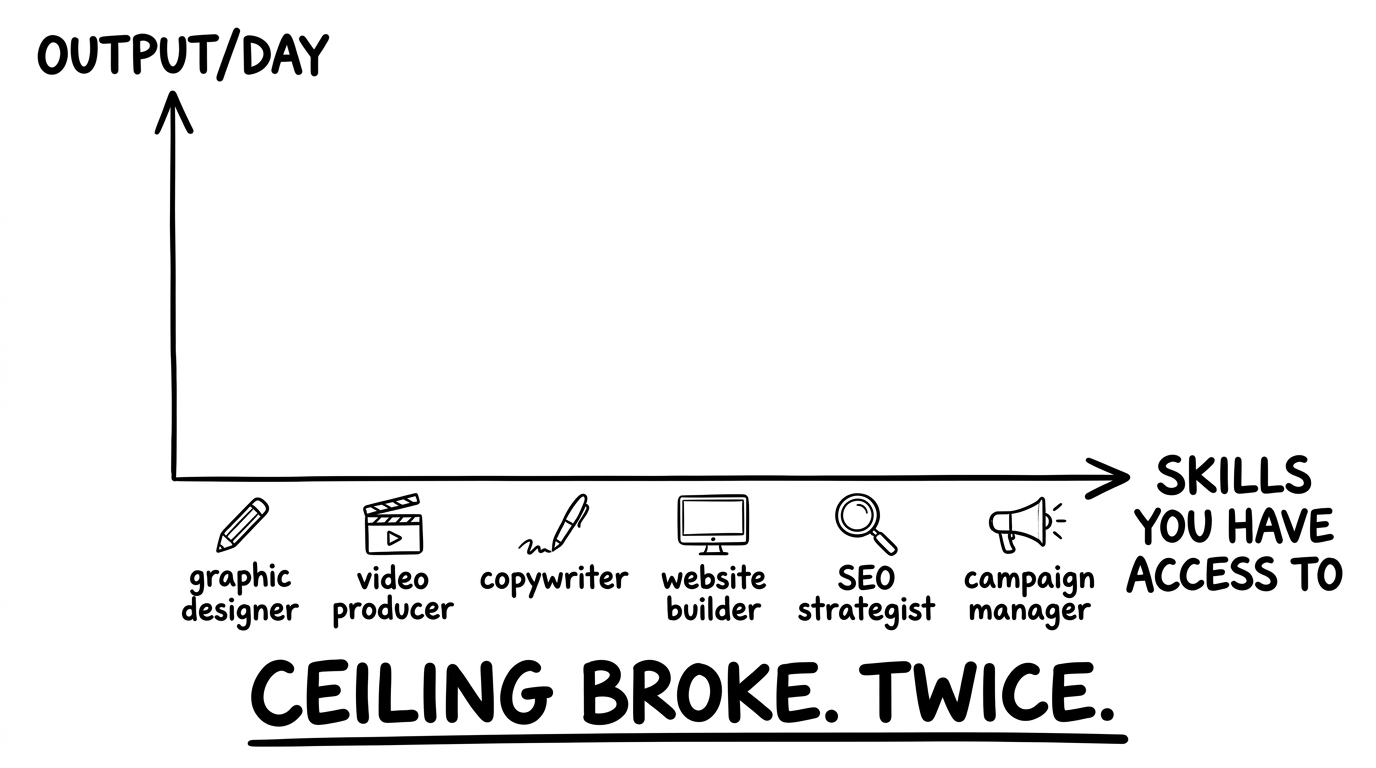
- AI just gained a second dimension of leverage. The first (output per day) is familiar. The second (skills you now have access to without hiring) is new.
- Most operators are fluent in one dimension. The ones pulling ahead are fluent in both.
- The second dimension only became real in the last five months, when agents like Claude Cowork started reliably completing multi-step work on real files, tools, and systems.
- Members of theCLICK Pro are shipping entire businesses, client systems, and lead magnets in single afternoons. None of them are developers.
- Becoming a 2D operator starts with naming the "pegs in the ground" you've been carrying. Pick one project you used to think was impossible. Ship version one this afternoon.
The ceiling broke twice.
Most AI operators are still playing on one axis: output per day. The ones pulling ahead are fluent in both dimensions, and the second one is what separates them.
This article breaks down the 2D AI Operator framework: what the two dimensions are, why the second one just became possible, and exactly how to start playing on both.
Why the Ceiling Broke Twice
We've had three waves of AI in the last four years.
Wave one was the chatbots. ChatGPT hit in late 2022 and every founder, freelancer, and Fortune 500 got curious. You typed into a box. It typed back. Sometimes it was helpful. Often it was boiled chicken (bland, generic, shaped like content but not actually useful).
Wave two was the reasoners. Models like o1 and Claude 3.7 started thinking before answering. Harder questions got better answers. The output quality jumped. But you were still typing into a box.
Wave three is the agents.
Claude Cowork. Claude Code. OpenAI Codex. The shift is that AI can finish the job on your real files, across your real tools, without you babysitting every step.
That shift broke a ceiling most operators didn't even know they were bumping into. It broke two of them, actually, and the second one is the one everyone's missing.
Dimension One: Output Per Day
The first dimension is the one you already know.
In the same eight hours, you produce more. A lot more. One operator today produces what three to five employees used to produce on the same team. That's a number I watch members hit inside theCLICK Pro every week.
This is where the whole "AI saves me time" narrative lives. And it's real.
Here's what it looks like on a standard marketing workload.
| Task | Old way | AI-operator way |
|---|---|---|
| Monthly content calendar (20 social posts + 4 blog drafts) | One person, 5-7 days | One person, 1 planning session |
| Email sequence (5 emails for a product launch) | One copywriter, 1 week | One operator, 1-2 afternoons |
| Landing page (copy + layout + live) | Copywriter + designer + dev, 2-3 weeks | One operator, half a day |
| Campaign launch end-to-end (pages, emails, ads, event content) | Small team, 3-6 weeks | One operator, 5-7 days |
That's the first axis. Every operator on this list is probably already somewhere on it. (If you're not, pause and read how to install Claude Cowork in about 20 minutes.)
But there's a second ceiling most people miss.
Playing on Dimension One alone is a trap.
You take the things you already do, and you do more of them faster. Same deliverables. Same playbook. Just faster.
That's useful but not the full story.
Dimension Two: Skills You Have Access To
The second dimension is the one almost nobody is playing on yet.
It's about what you can produce at all. Skills you used to hire for. Work you used to outsource.
Six skills used to be hire-or-don't-do-it. In the last few months, they flipped:
- Graphic design. You used to need a designer, or Canva with patience, or both.
- Video editing. Hire or don't ship.
- Copywriting at quality. Hire or write three drafts and hope.
- Web development. Hire or live and die by WordPress templates.
- SEO. Hire an agency or give up and buy ads.
- Campaign management. Hire a marketing manager or skip the launch.
Today all six are solo-accessible. Not "AI makes it easier." Accessible. You can ship all six, at a level that competes, without hiring anyone.
That's the compounding part.
Once you have access to a skill, it's permanent. Next week you don't need to hire a designer for the new offer. Next month you don't need to hire a dev for the landing page. Next quarter you don't need to hire an SEO to publish the pillar article. The leverage keeps compounding.
That's Dimension Two. Most operators aren't on it yet.
What This Looks Like in Practice
Inside theCLICK Pro, we've been watching this happen in real time.
Here are just nine of the hundreds of members who shipped real work in single afternoons over the last few months. Not prompt-library experiments. Paid businesses. Client systems. Offers that make money.
Here's the field report.
| Member | Background | What they built | What they skipped hiring for |
|---|---|---|---|
| Fred White | Mechanic shop + pet shop owner (NJ) | Paid membership for local shop owners. BuildABetterShop.com, built in ~30 minutes on a Sunday afternoon. $30/mo, paying members in week one. | Web dev, copywriter, designer |
| Victoria Westcott | Filmmaker + cleaning business co-owner | "1,000 Rejections" outreach agent. 83 pitches out, 7 acceptances (including a major entrepreneurship podcast) in weeks. | Virtual assistant, outreach manager |
| Ash Samawi | Former restaurateur (Dubai), now cleaning business owner | Custom cleaning-metrics app: bookings, applicant tracking, client heat-map by postal code. Replaced QuickBooks + bookkeeper workflow on a $25K/mo operation. | Developer, bookkeeper |
| Julie Blackburn | Copywriter (Australia) | 15 pages of client website copy, sorted 1 TB of photography, plus a prototype site to present the copy live. One day. (Normally a two-week job.) | Web designer, photo editor |
| Michael Longfellow | Agency owner | AI agent that generates qualified leads for a litigation client. Cases worth $20,000 each. | Lead-gen specialist, SDR team |
| Debbie Collins | Email marketer (Klaviyo specialist) | Klaviyo audit agent. Delivers a $1,000 front-end offer in minutes that used to take days. | Technical analyst, data engineer |
| Claudia Cesarotti | Pet-industry marketer | Full lead-magnet funnel for veterinarians: 43-page ebook + landing page + delivery. Whole thing, solo. | Developer, designer, marketing ops |
| Amanda Jefferson | Productivity coach | Interactive Day Planner, sold as a $37 tripwire. $1,700+ in the first 18 hours across 50 sales. | Product designer, web dev |
| Nikki Stine | Small-business marketer | Social Content Engine. One planning meeting now produces a month of posts across Facebook, Instagram, LinkedIn, and Google Business. | Content manager, social media specialist |
Nine operators. Nine afternoons. Zero developers.
What they have in common is that they stopped believing the second axis was off-limits. No code skills required. No technical chops. No youth needed. (Diane Anderson, 70+, is building a second career inside theCLICK Pro.) Just the willingness to pull the peg.
The Peg in the Ground
There's a story about a baby elephant.
You tie the baby to a stake with a rope. The baby pulls. The rope holds. The baby pulls harder. The rope still holds. Eventually the baby stops pulling and learns: this peg cannot be moved.
Years later, the elephant is enormous. Thousands of pounds. It could pull that peg out of the ground without noticing. But it never tries.
Every operator has a peg.
"I'm not technical." "I'd need a developer for that." "That needs a whole team to pull off." "I'd need money I don't have." "I'm too old for this."
These are the pegs. Most of them were true once. None of them are true now. Agents finish the jobs you used to need other people for, and the peg that's been in the ground for a decade can be pulled up in an afternoon.
The dangerous failure mode here is that you've told yourself for so long that you can't build, the self-talk runs on autopilot.
Robin, the persona we serve at theCLICK, has real expertise. Fifteen to twenty-five years of hard-won pattern recognition. The peg is a story she's been telling herself about her own capability.
If you're reading this, that story might be out of date.
How to Start Playing on Both Axes
Three steps. Not a course. Not a framework to memorize. Three things you can do today.
- Write down the pegs. List three to five things you've been telling yourself you "can't build." Websites. Funnels. Video courses. Lead magnets. Agents. Campaigns. Whatever keeps coming up and getting put back on the shelf.
- Pick one project that used to be impossible. Not a "produce more of what I already do" project. A "couldn't-have-built-this-last-year" project. The version of you from 18 months ago would have quoted this job out to three different people. You're going to build it yourself.
- Ship version one this afternoon. Not perfect. Shipped. Then show it to one real person the same day. Fred's first move was a chamber of commerce talk. Victoria's first move was a Leo Brunch. Amanda's first move was a $37 tripwire to her productivity audience. Small, trusted, real.
The tool move underneath all three: get off the chat box.
Chat is fine for quick questions. It's not where leverage lives. Leverage lives on agents that work on your real files and tools. That means desktop apps and real context, not tabs open to chat.com. Install Claude Cowork on your Mac or PC. Run the Growth OS Quick Start. Your agent will know your offers, your voice, and your customer before it writes a single word. That's the starting line.
Then pick your peg and pull.
The Bigger Picture
The 2D AI Operator is a leverage story.
Every major business-building era (Google in the 2000s, Amazon mid-decade, social mid-2010s, content late-2010s) created a 10-year window where early operators compounded disproportionate advantage. This one is bigger. The operators who get fluent in both dimensions in 2026 will look obvious in 2027. The ones still playing on one axis will look obvious for a different reason.
You've been carrying ideas. Websites you've wanted to build. Offers you've wanted to launch. Campaigns you've had half-drafted for six months.
The peg isn't in the ground anymore.
The only question is what you pull up first.